Know whichswitch portyou are on.
It reads the switch’s own LLDP and CDP advertisements to tell you the physical port and VLAN you are plugged into — then scans the subnet, opens the SSH or serial session, and moves the files. One window, twelve tools.
- Version
- 0.7.1
- Size
- 7.0 MB
- Windows
- 10 / 11 · x64
- Price
- Free
What you get done with it
Six questions it answers on site
Not a feature list — the things you actually needed answered before you could finish the job.
- 01
Which switch port am I on?
Read the switch's own LLDP or CDP advertisement and get the switch name, physical port, VLAN and management IP — for every adapter at once.
How it works→ - 02
What is on this subnet?
Sweep it and get hosts back with MAC vendor, hostname and latency, then open SSH, SFTP or RDP against one without retyping the address.
How it works→ - 03
Is the service actually listening?
Scan TCP and UDP across a host, a range or a whole /24, with live hosts found first so you are not scanning 254 empty addresses.
How it works→ - 04
Get me on the equipment
Tabbed SSH with saved connections and key authentication, or a serial console when the device has no working address yet.
How it works→ - 05
Move the config and the firmware
SFTP over the same saved connections, with an editor for the one line you came to change.
How it works→ - 06
Is it the network?
Gateway, DNS and internet checked in one pass, with loss and jitter figures you can put in a ticket instead of an opinion.
How it works→
How the app is shaped
Built around the order you actually work in
Arrive on site, work out what you are plugged into, find what is on the network, decide whether the fault is yours, get onto the kit, move the files. The app is organised the same way.
Which physical port, which VLAN, which switch — before anything else.
In the box
Twelve tools, one installer
Each one is documented with what it does and where it stops.
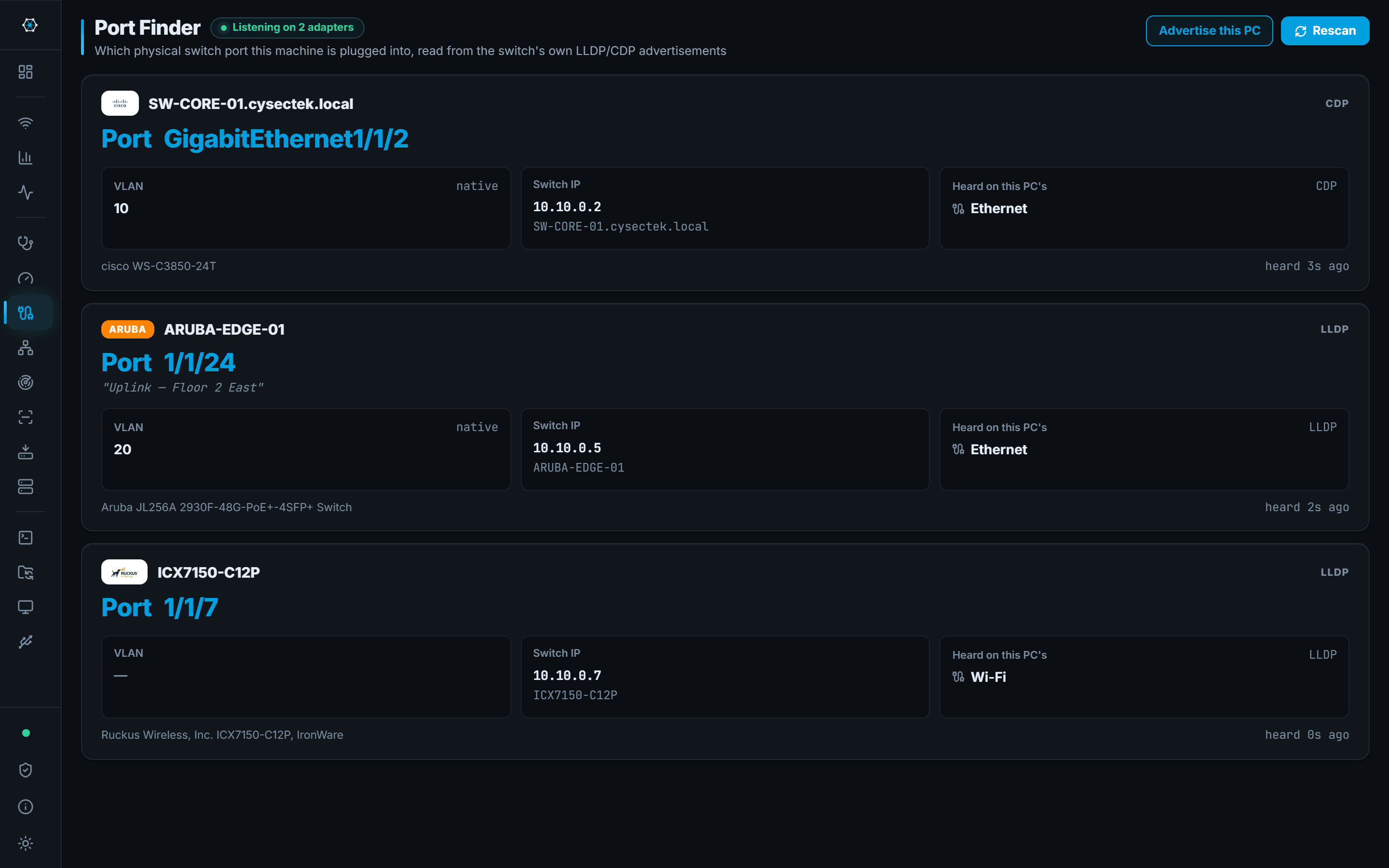
Port Finder
Which switch port this machine is plugged into, read from the switch itself.
Port Finder listens for the LLDP and CDP frames switches broadcast on their own. When one arrives it reports the switch name, the physical port, the port description the switch administrator wrote, the native VLAN and the switch's management IP — for every adapter on the machine at once, so a laptop on both Ethernet and Wi-Fi shows both.
- The switch name and port for the lead you are holding
- Native VLAN and the port description the network team wrote
- The switch's management IP, ready to SSH into
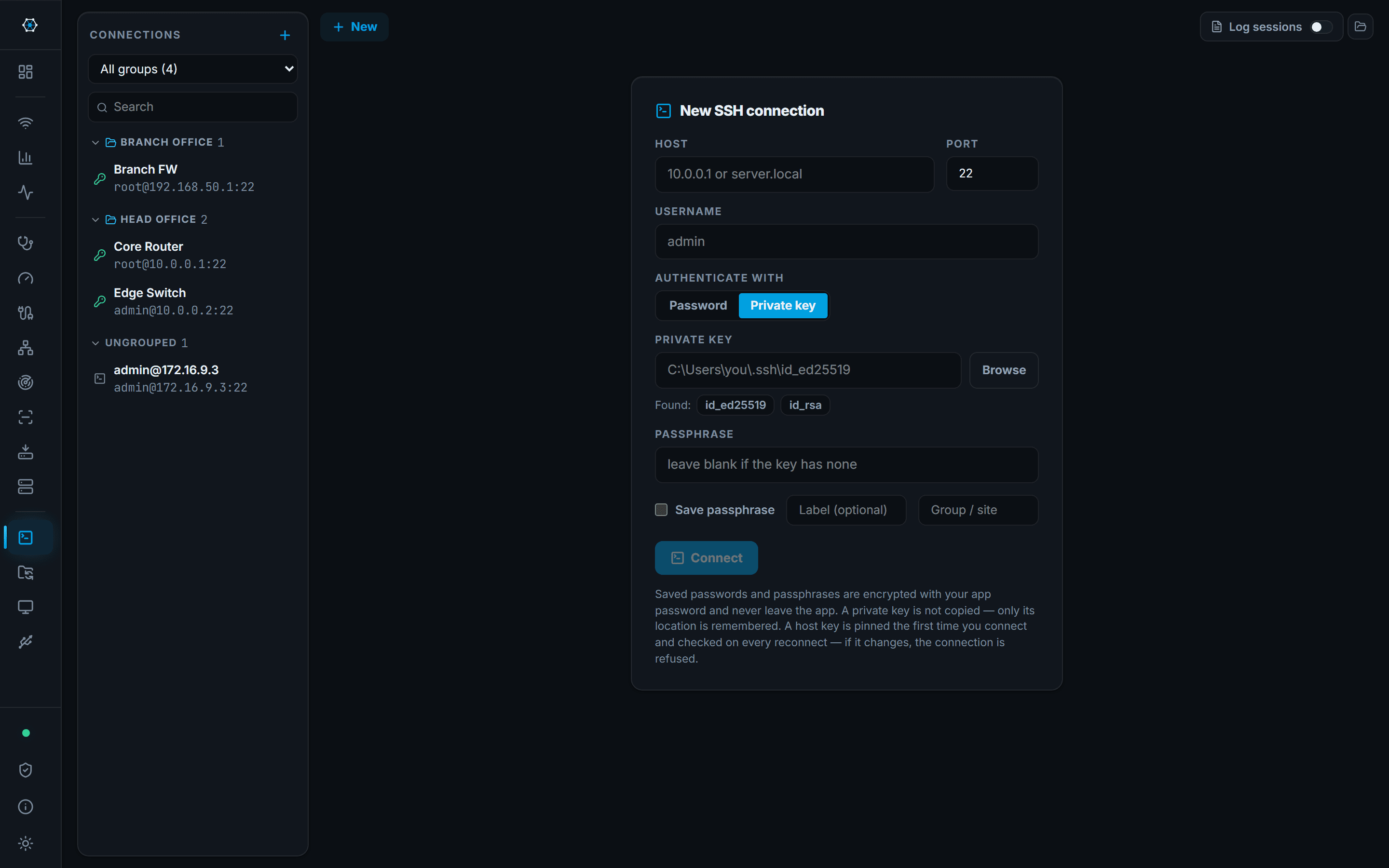
SSH
A tabbed SSH terminal with saved connections and encrypted credentials.
Sessions are tabs. Saved connections live in folders per site or customer, searchable, most recently used first. Authentication is a password or a private key — OpenSSH format, Ed25519, RSA or ECDSA, encrypted keys included — and any key already in ~/.ssh is offered on the connection form.
- Five switches as five tabs in one window
- Password or private key authentication, saved and encrypted
- A refused connection when a host key changes, not a dialog nobody reads
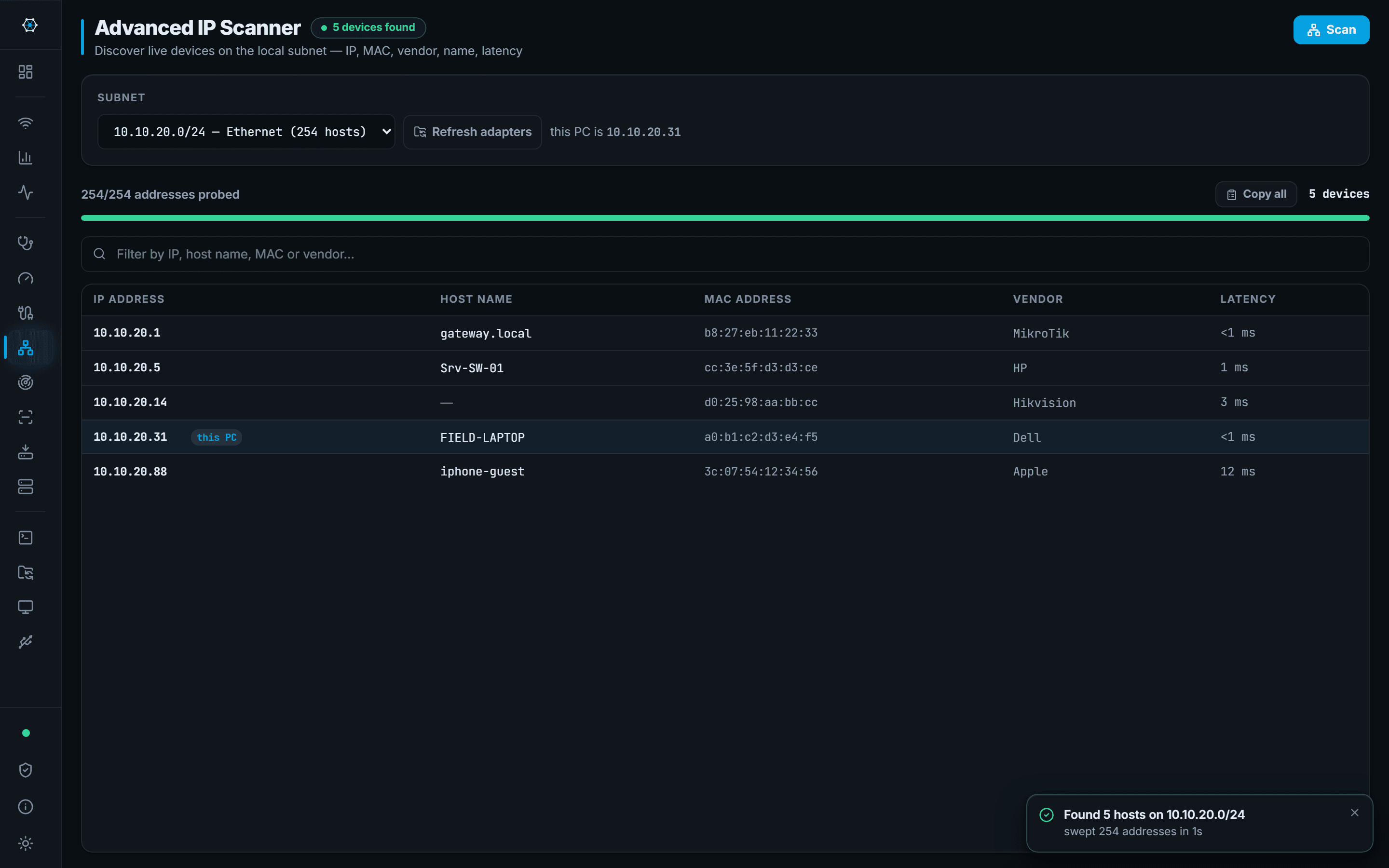
IP Scanner
Sweep a subnet and get names, MAC vendors and latency back.
Pick a subnet — the app lists the ones this machine is already on — and sweep it. Hosts come back with their IP, MAC address, the vendor that MAC belongs to, a resolved hostname where there is one, and a round-trip time.
- A list of live hosts on the subnet, with vendor and hostname
- Latency per host, so a slow one is visible immediately
- A direct route from a discovered host into SSH, SFTP or RDP
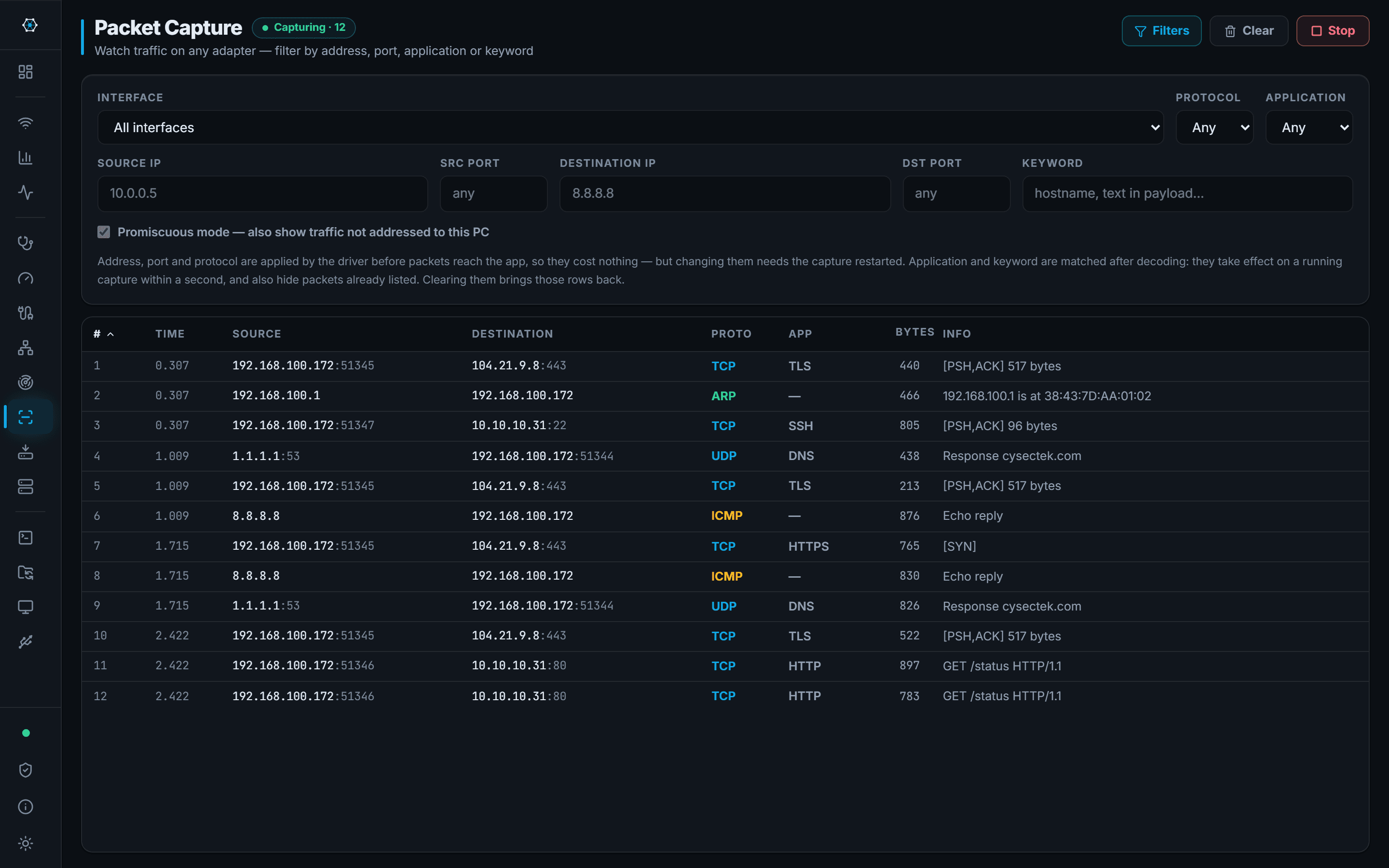
Packet Capture
Live capture on one adapter or all of them, with filters you can change mid-run.
Address, port and protocol filters are compiled to BPF and applied by the driver, so the filtering happens before the packets reach the app. Application and keyword filters are matched after decoding and can be changed while the capture runs.
- Confirmation that traffic is or is not arriving on an interface
- A quick read on which hosts and applications are talking
- DNS and HTTP request visibility without a full analyser
Who it is for
People who go to the equipment
If your job involves standing next to a rack, or talking someone else through one, this was built for you.
Network engineers
Switch port, VLAN and console access on the same screen as the terminal you were going to open anyway.
Field-service technicians
One installer on the laptop instead of six, and it works on a site you have never been to before.
Infrastructure administrators
Saved connections per site, encrypted credentials, and transcripts of what was changed.
IT support teams
Answer 'is it the network?' with loss and jitter figures rather than an opinion.
Managed service providers
A connection tree per customer, and provisioning services you start for a job and stop after.
Data-centre technicians
Identify the port a lead lands on before tracing it by hand.
Security-conscious operations teams
Credentials encrypted under a password the machine does not hold, host keys pinned, transcripts encrypted at rest.
Trust
Credentials encrypted under a password your machine never stores
The app password is not a screen lock. A key is derived from it with Argon2id and encrypts your saved SSH, SFTP and RDP passwords with ChaCha20-Poly1305 — so a credential file copied off the machine is useless without it.
- Host keys pinned
- Recorded on first connect. A changed key is refused, with both fingerprints shown when a device really was rebuilt.
- Transcripts encrypted
- Off by default. When on, encrypted at rest — a switch session prints running-config and SNMP communities.
- No telemetry
- No analytics, no account, no usage reporting. Scan results and credentials stay on your machine.
- Updates verified
- HTTPS only, our host only, SHA-256 checked before anything is applied.
Honestly
What it does not do
Every tool here has a specialist that beats it. Knowing which is which saves you finding out on site.
It is not Wireshark
Capture is a visibility check: one line per packet, no detail tree, no follow-stream, no pcap files. For real trace analysis use Wireshark.
It is not Nmap
No OS fingerprinting, no service-version detection, no scripting engine. For security assessment work, use Nmap.
No SSH tunnelling or jump hosts
No port forwarding, no bastion support, and no SSH agent. If you reach kit through a jump host, keep the tool that does that.
Windows only, and unsigned for now
No macOS or Linux build. The installer is not code-signed yet, so SmartScreen will warn — verify the SHA-256 instead.
Side-by-side with the tools you already use: honest comparisons.
Get it on the laptop before the next call-out
One 7 MB installer. No account, no licence key, no trial period.
- Operating system
- Windows 10 or Windows 11, 64-bit (x64).
- Extra dependencies
- Npcap, only for Port Finder and packet capture.
- Administrator
- Only for packet capture. Everything else runs as you.
Before you run it